The Science Behind Lonedog's Movement System: Why Your Body Has a Unique Blueprint
No Two Bodies Are the Same. So Why Does Your Gym Treat Them That Way?
Walk into most gyms in Albury-Wodonga—or anywhere in Australia—and you'll find the same thing: a whiteboard with today's workout.
Everyone does the same squats. The same deadlifts. The same lunges. The same conditioning circuit.
The person with the healthy hips does them. The person with the dodgy knee does them. The person who slept well does them. The person who's been doing physical labour for 10 hours does them.
Same movements. Same load. Same expectation.
This approach ignores something fundamental: your body has a unique blueprint.
Your movement patterns, your joint health, your mobility restrictions, your strength imbalances, your recovery state—these are different from every other person in that gym. And they change day to day.
At Lonedog, we adopted a Mechanical 4Q System to solve this problem. It's a daily movement assessment and programming framework that creates a genuinely individual training experience—one that adapts to your body's unique blueprint every single session.
Here's what it is, why it works, and what it means for your training.
What Is the Mechanical 4Q System?
The "4Q" stands for the four quadrants we assess to understand your movement readiness:
Quadrant 1: Unloaded Linear Movements
How your body moves itself in straight lines. Range of motion available, stability without external load, any pain or compensation patterns. e.g push ups, chin ups, lunging, walking, bending.
Quadrant 2: Unloaded Multidirectional Movements
How your body organises itself while moving through the field of gravity. Rhythm & timing, imbalances between sides, and any present limitations. e.g crawling, ground to standing, rotating, twisting.
Quadrant 3: Loaded Linear Movements
How your body performs when moving an external weight against gravity. Maintaining of standards when an external load is introduced. e.g squats, bench press, deadlifts, rowing.
Quadrant 4: Loaded Multidirectional Movements
How your body self organises while shifting weight with a vector variety. Does it flow or is it clunky? e.g throwing, striking, shifting, warding.
Each quadrant is assessed daily—not through a lengthy clinical process, but through a refined warm-up and ongoing movement observation that takes seconds-minutes and provides critical information about how to design your session.
The Daily Movement Observation: What It Looks Like in Practice
You arrive at Lonedog for a session. Here's what actually happens before any serious training begins.
The Conversation
“How'd you sleep? How's your body feeling today? Anything sore or tight?”
These aren't small talk. They're data.
Your subjective experience of your body is the most valuable piece of information we have. A coach who actually listens to this and adjusts accordingly is providing genuinely personalised service. A coach who ignores it and runs the prescribed program is providing a standardised service with a friendly face.
The Movement Warm-Up Assessment
As you warm up, we're observing and gathering information:
Upper body observations:
Shoulder mobility during hand-on-body & body-on-hands exercises
Symmetry between sides
Any guarding, compensation, or pain-avoidance patterns
How the shoulder blade moves (or doesn't)
Lower body observations:
Hip mobility in dynamic warm-up movements
Knee tracking during body weight motion
Single-leg stability and balance
Ankle restriction and its effect from the ground up
Spinal assessment:
Thoracic mobility (upper back rotation and extension)
Lumbar control and stability
Spinal Organisation (a critical movement skill for safe loading)
Performance markers:
How movement quality changes with the first few working sets
Recovery between efforts
Any changes in technique under fatigue
The 4Q Rating
After the warm-up assessment, each quadrant gets a readiness rating:
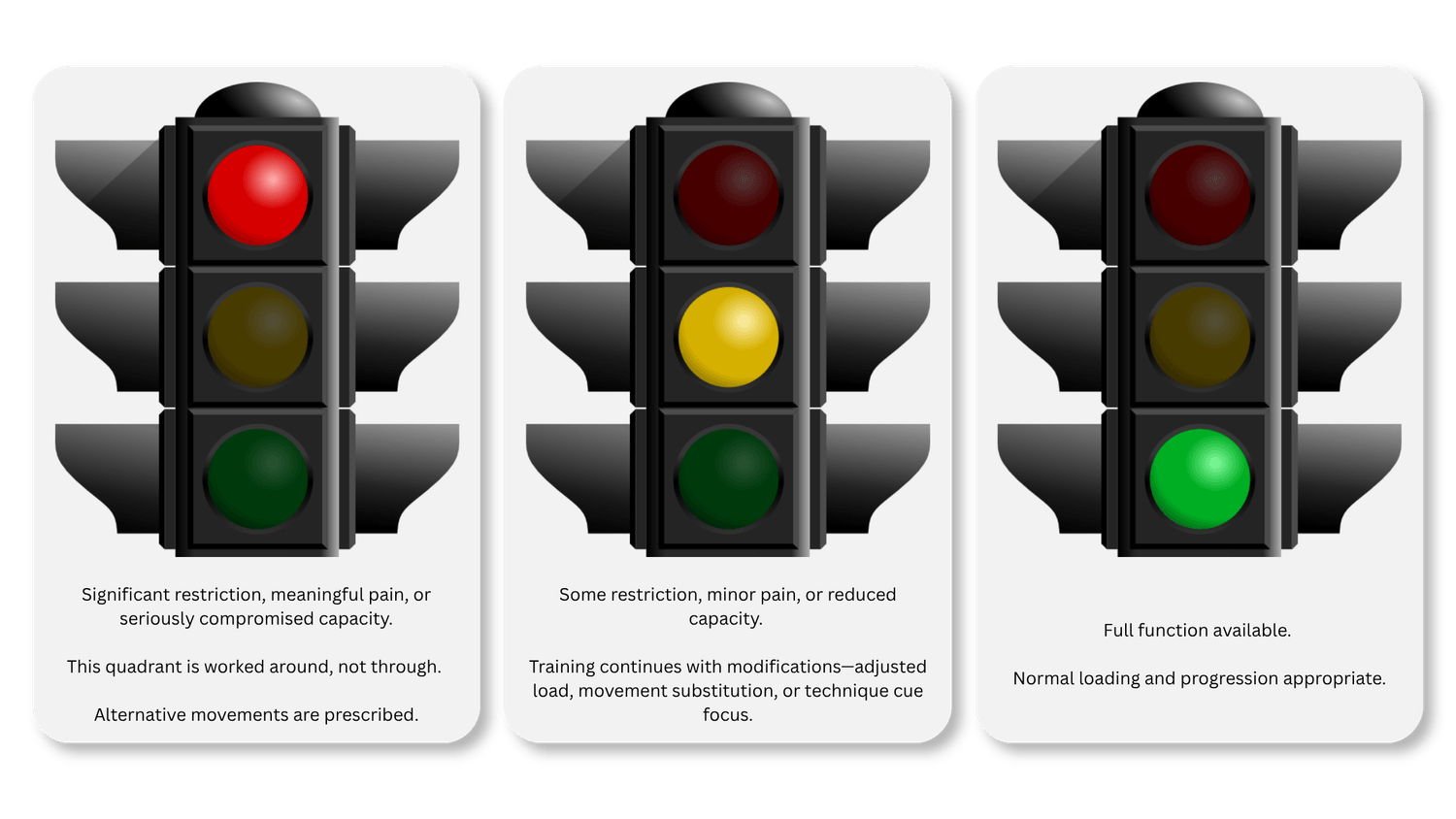
A training session can have different colours across the four quadrants. Maybe your Unloaded Movements are green, but your Loaded Movement is yellow because of hamstring tightness. That means body weight sessions progress normally while lower body hinge work gets modified—not the whole session.
This granularity is what makes the system genuinely individualised.
Why Movement Quality Comes First (Always)
Some people first hear about the 4Q System and ask: “Why do we spend time on this instead of just getting into the workout?”
It's a fair question. Here's the honest answer.
Loading Poor Movement Makes It Worse
Here's one of the most important principles in exercise science: strength training reinforces existing movement patterns.
If you have a compensatory movement pattern—say, your left hip hitching during squats because of limited mobility—and you add 100kg to a barbell and squat for 3 sets, you haven't just trained your legs. You've trained and reinforced that compensatory pattern under load.
Do that for months, and the compensation becomes harder to correct. Do that for years, and it often becomes the movement breakdown that causes injury.
The 4Q System prevents this by identifying and addressing movement dysfunction before it gets loaded.
We don't ask your body to do movements it can't do well. We work with what you have and progressively expand it, so the movements you load are movements your body is genuinely ready to perform.
Pain Is Information, Not Weakness
When a movement hurts, most gym programs offer two options:
1. Stop doing it.
2. Push through it.
The 4Q System offers a third option: understand what the pain is communicating and address it properly.
Pain during movement may indicate:
Insufficient mobility for that movement (the joint can't reach the range required)
Tissue sensitivity from previous injury or current inflammation
Poor motor control (the brain and nervous system haven't yet learned to coordinate the movement safely)
Compensation patterns creating load in the wrong places
Structural issues that require medical assessment
Each of these has a different solution. The 4Q System is designed to differentiate between them—to the extent possible without clinical assessment—and prescribe training that works with the pain signal rather than against it.
Movement Quality Unlocks Performance
Here's the performance argument for movement quality, beyond just injury prevention:
You cannot express your full-strength potential through a restricted movement pattern.
If your ankle mobility prevents you from achieving depth in a squat, you'll never maximise your squat strength, no matter how strong your legs are. The bottleneck is mobility, not strength.
If your thoracic spine can't extend through the range required for an overhead press, your shoulder, and arm strength can't be fully expressed. The bottleneck is mobility.
Improving movement quality doesn't just reduce injury risk, it unlocks the full expression of your strength and athletic capacity. Members who go through the movement-quality foundation phase at Lonedog consistently find that their performance lifts more quickly once restrictions are addressed than they did when they were trying to train around them.
The MetCon 4Q: Applying the System to Conditioning
The Mechanical 4Q System isn't just for strength work. It extends to conditioning through what we call the MetCon 4Q framework, metabolic conditioning designed around your daily readiness.
Traditional conditioning programs prescribe fixed workouts: specific intervals, specific distances, specific intensities.
The MetCon 4Q adapts the conditioning prescription to your daily readiness state.
High Readiness Conditioning
When your 4Q assessment shows high readiness across all quadrants—good sleep, low stress, no significant restrictions, full movement quality available:
Higher intensity intervals
Shorter rest periods
Complex movements requiring full mobility
Challenging metabolic demands
Progressive overload on previous sessions
Moderate Readiness Conditioning
When readiness is mixed—some restriction, moderate energy, manageable stress:
Moderate intensity maintained
Movement substitutions where needed
Slightly longer recovery between efforts
Focus on technique maintenance under fatigue
Quality over maximum output
Moderate Readiness Conditioning
When readiness is low—poor sleep, high stress, significant restriction, or low energy:
Aerobic conditioning at lower intensity
Movement quality focus over metabolic demand
Active recovery protocols
Longer rest periods
Nothing that significantly compounds existing fatigue
This isn't about doing less when you feel bad. It's about doing appropriately based on what your body can actually recover from and adapt to.
Training at high intensity when your readiness is low doesn't produce more adaptation, it just accumulates more stress on top of an already-stressed system. The MetCon 4Q prevents this by calibrating the conditioning stimulus to your actual recovery capacity.
How Your Movement Blueprint Develops Over Time
Here's something fascinating that members experience over months of training with the 4Q System:
Your blueprint changes.
The restrictions that showed up in your initial assessment—the limited hip mobility, the tight thoracic spine, the restricted ankle—don't stay that way forever. With targeted mobility work, progressive loading, and intelligent programming:
Range of motion improves
Compensation patterns reduce
Movement quality increases under load
The 4Q profile shifts greener across all quadrants
What was yellow becomes green. What required modification becomes full expression.
This progression is tracked explicitly at Lonedog. We reassess periodically and show you the changes—not just in performance metrics like weight lifted, but in the foundational movement quality that makes sustainable performance possible.
The result: After 6–12 months of training with the 4Q System, most members have a dramatically different movement profile than when they started. More mobility, more stability, more capacity—and a body that holds up better in every area of life.
The Coaching Philosophy Behind the System
The Mechanical 4Q System didn't emerge from theory. It was built from practice—from years of working with thousands of different bodies and learning what actually produces durable results.
Lonedog coaches have been mentored by experts from across the world, across different disciplines and specialities. Rather than adopting one approach and applying it dogmatically to everyone, we took what worked from each and integrated it into a coherent system that can serve anyone who walks through the door.
“Rather than just choose one component of exercise and then let the dogma of that rule the way we do things,” as our coaching philosophy describes it, “we've been able to take all these pieces and fit them together in this sort of rich tapestry that allows us to serve people better.”
It doesn't start with an exercise and ask how to apply it to you. It starts with you and asks what exercises are appropriate.
This reversal—from program-centred to person-centred—sounds simple but is genuinely rare in the fitness industry. And it's the foundation of why Lonedog's approach produces the results it does.
The 4Q System is the practical expression of that philosophy.
It doesn't start with an exercise and ask how to apply it to you. It starts with you and asks what exercises are appropriate.
This reversal, from program-centred to person-centred, sounds simple but is genuinely rare in the fitness industry. And it's the foundation of why Lonedog's approach produces the results it does.
What This Looks Like for Different Albury-Wodonga Members
The 4Q System's versatility is one of its most important features. Here's how it works for different people.
The Returning Athlete
A 42-year-old who played footy in their 20s and is returning to structured training after years away.
Initial 4Q assessment:
Unloaded Linear Overhead Push: yellow (rotator cuff history)
Loaded Movement Lunge: yellow (knee history)
Everything else: manageable
Early program: Modified upper body pushing (single sided dumbbells rather than bilateral barbell work), TRX-assisted lunging patterns, direct mobility work for shoulders and knees.
6-month progress: Rotator cuff addressed through targeted work, knee mechanics improved through hip and ankle mobility development. Full upper body pushing available, multidirectional lunges with appropriate load.
The New Gym-Goer
A 28-year-old with a desk job who has never trained consistently before.
Initial 4Q assessment:
Thoracic mobility: restricted (desk posture)
Ankle mobility: restricted (sedentary lifestyle)
Hip mobility: limited
Everything else: untrained but functional
Early program: Thoracic mobility work as warm-up, goblet squats with heel elevation while ankle mobility develops, Romanian deadlifts before loading full range, upper body work without overhead loading until thoracic spine opens.
6-month progress: Thoracic mobility significantly improved, ankle mobility developed, squatting with greater depth, pressing overhead comfortably. Full 4Q assessment now largely green.
The Active Older Adult
A 58-year-old who wants to keep hiking and playing golf into their 70s and 80s.
Initial 4Q assessment:
Various restrictions related to age and history
Some pain with certain movements
Well below full range in several quadrants
Program approach: 100% movement-quality focus. Mobility work woven throughout.
Strength work at appropriate loads. Gradual range of motion expansion. Zero pain in training at all times.
Outcome: Hiking further without knee pain. Golf improving with better thoracic rotation. Feels more capable in daily life than they have in years.
Common Questions About the Mechanical 4Q System
No. The coaches run the assessment and design your session accordingly. You experience the benefit without needing to understand the framework in detail. Over time, most members naturally develop their own body awareness and begin to understand their own patterns—but this happens organically.
Not at all. The 4Q System benefits everyone because everyone has unique movement patterns and daily variation in readiness. For healthy people with no injury history, it still ensures training is appropriately calibrated to their capacity each day.
The assessment is integrated into the warm-up. Most of the information is gathered in 5-10 minutes without any separate "assessment session"—coaches observe during warm-up and ask a few key questions. For new members, initial assessments are more thorough.
You can develop body awareness over time, and we encourage this. But the 4Q assessment genuinely benefits from trained eyes observing from outside your body—catching compensation patterns you can't see yourself and movements that feel fine but look problematic.
Physio assessments are clinical—they're focused on diagnosing injury, managing pathology, and determining when it's safe to train. The 4Q System is a coaching tool—it's focused on designing the best possible training session given your current state. They serve different purposes and work well together.
Your Unique Blueprint Deserves a Unique Approach
Your body is not average.
Your movement history, your joint structure, your mobility patterns, your daily fluctuations in readiness—none of these are the same as the person next to you.
So why train like they are?
The Mechanical 4Q System exists because we believe you deserve training that's actually designed for you—not training designed for a theoretical average that's then applied to you.
This is how we help Albury-Wodonga members build genuine athleticism without breaking down. Not by ignoring what makes your body unique, but by making that uniqueness the foundation of everything we design.
Ready to discover your movement blueprint?
Book an intro session at Lonedog's location. We'll run through the 4Q assessment, show you where your body is thriving and where it has room to develop, and design your first session around what we find.
No guessing. No generic programs. Just training that's genuinely built for you.
Get started today.
Book A Complimentary Consultation
Fill out the form below, and we will be in touch with you in 24 hours.